
Finding People Through Sanford Records
The best starting point depends on what is known. A current or recent address belongs in the Lee County tax search, which connects a parcel to its owner and a separate tax-mailing address. A full name can go to the statewide eCourts Portal, official business filings, or an agency directory. An older address may work better in a Hill’s city directory because its street guide reverses an address to an occupant. Family events lead to the Register of Deeds, historical indexes, newspapers, and the State Archives.
Sanford is the Lee County seat, but most person-level records are not kept by the city. County offices hold deeds, parcel data, court files, and local certificates. State agencies publish voter, correctional, business, license, vital, and unclaimed-property tools. City files add council records, permits, inspections, project files, and staff contacts. Keep the source’s role in view. A tax owner is not always a resident, and a name on a deed or court docket identifies a record party rather than a current address.
- Write down the name, former surname, address, date range, and relationship already known.
- Search the Lee County property roll by owner or address and save the PIN and deed book/page.
- Check the eCourts party search, then use a courthouse terminal if the public web result is thin.
- Move older names through Sanford and Jonesboro directories, newspapers, and Moore or Chatham sources when dates require it.
- Ask the correct custodian for an existing record when no online search reaches it.
The official Census QuickFacts profile for Sanford shows why names often need a second identifier in a growing city.
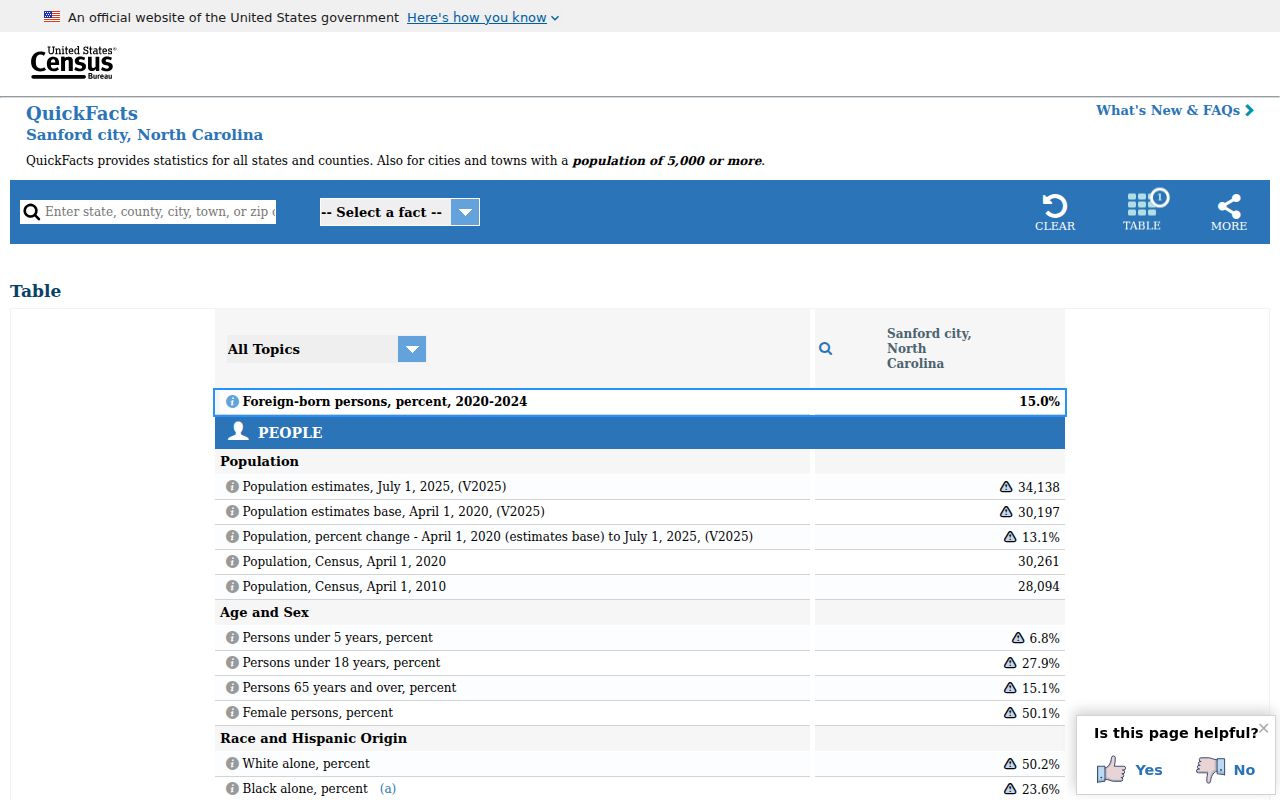
Use population facts as context only. They cannot identify a household or settle whether two similar names belong to the same person.
Sanford People Search Offices
Three offices form the core local record trail. The Lee County Register of Deeds keeps recorded land transactions and county birth, death, and marriage records. The elected Clerk of Superior Court holds civil, criminal, estates, probate, special-proceeding, and divorce files. Lee County Tax Administration links names and addresses through the property roll. The City Clerk manages municipal records, but Sanford has no separate municipal court and no general city clerk who holds deeds or trial files.
Lee County Register of Deeds
1300 S. Horner Blvd.
Sanford, NC 27330
(919) 718-4585
Lee County Court Clerk
1400 S. Horner Blvd.
Sanford, NC 27330
(919) 718-6300
Certification, access limits, and copy charges depend on the record and custodian. The complete office and request breakdown belongs with Sanford public records access. Calling ahead is useful when a historical volume, paper court file, or certified copy cannot be handled through the web.
Search Sanford Property Owners
The Lee County Real Estate Property Search is the strongest official bridge from a Sanford address to a person or entity. Search modes cover owner name, property address, parcel ID or PIN, mailing address, sales, and advanced criteria. A wildcard can help with an uncertain street or name. Results may be selected for CSV export, while the Residential PRC option produces a property record card.
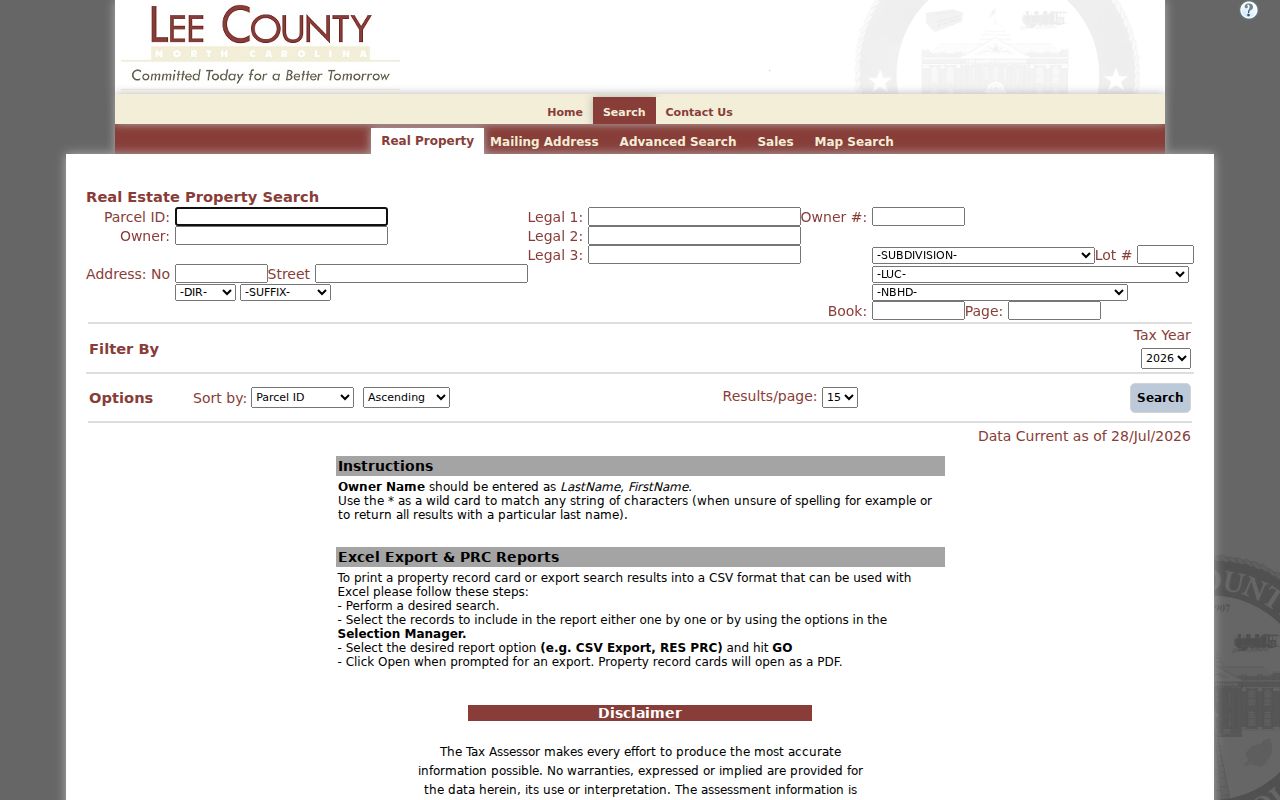
The search form supports both directions: name to parcel and address to owner. Always compare the physical, or situs, address with the mailing address. They serve different purposes and may point to different places.
| Search choice | Use it when | Carry forward |
|---|---|---|
| Owner name | A surname or entity is known | PIN, account, physical address |
| Property address | A Sanford street address is known | Owner and tax-mailing address |
| Parcel ID / PIN | A stable parcel key is known | Deed and plat references |
| Mailing address | Related holdings may share a tax destination | Selected results and CSV export |
Assessment pages can lag ownership or physical changes. Treat the result as a lead, then verify a conveyance through the Register of Deeds.
Read a Sanford Parcel Record
A full Lee County parcel profile contains more than value. It can show the owner display name, ownership percentage, mailing and physical addresses, neighborhood, zoning, land use, deeded acreage, permits, recorded transactions, and plat cabinet or slide. The transaction rows may supply a date, book, page, instrument, price, and validity code. Those citations turn a tax result into a path through prior deeds.
An inspected Lee County parcel profile demonstrates how the owner, location, permit, and deed sections fit together.
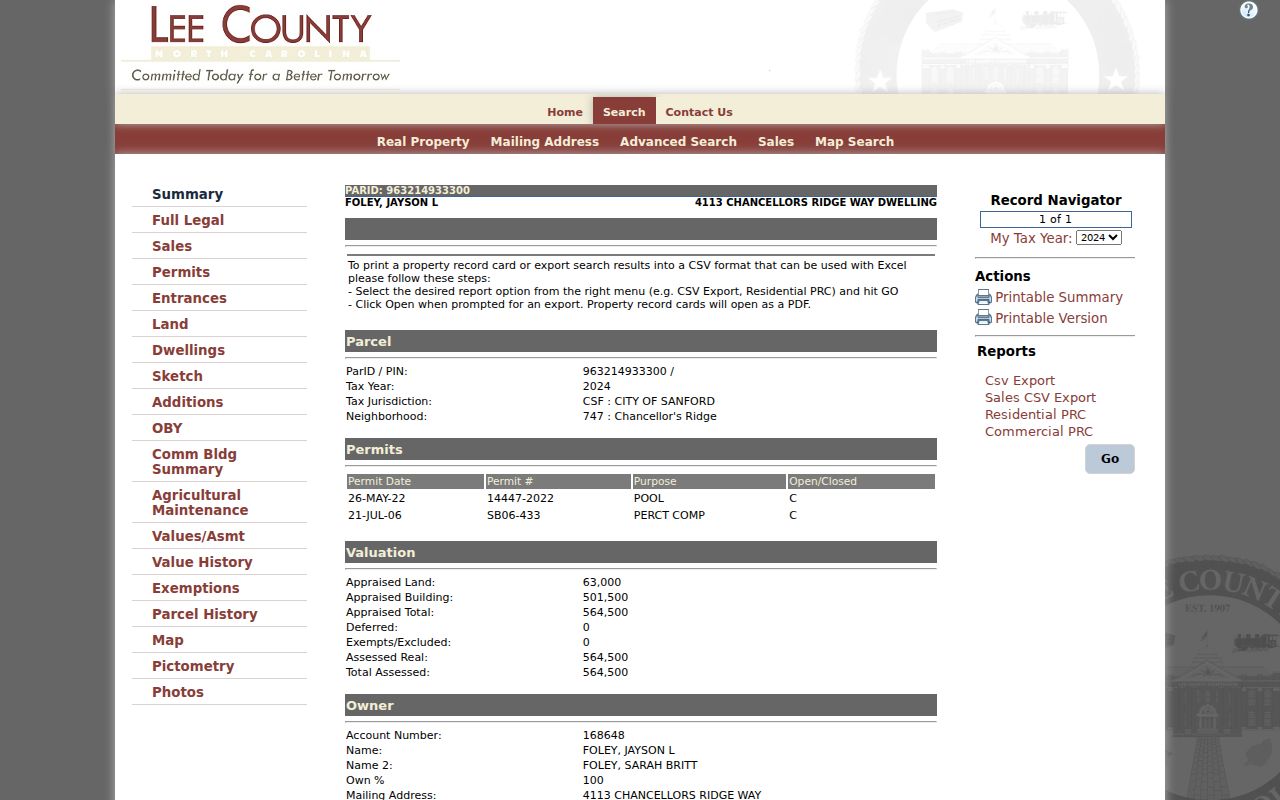
Begin with the newest deed book and page, open that instrument through the Register of Deeds, note the prior grantor, and work backward. The parcel PIN and legal description are usually safer cross-checks than a street spelling alone.
- PIN
- The county’s geographic parcel identifier.
- Situs address
- The physical location of the land, not the owner’s mail destination.
- Grantor
- The party transferring an interest in a recorded deed.
- Grantee
- The party receiving the recorded interest.
- Plat
- A recorded survey map tied to a cabinet and slide or similar reference.
Map Sanford Records Jurisdiction
A Sanford mailing line does not prove that land lies inside city limits. Lee County’s GIS service includes parcels, Sanford, Sanford ETJ, the county boundary, townships, historic districts, and special districts. ETJ means extraterritorial jurisdiction, an area outside the city where Sanford may exercise planning authority. Pair those boundaries with the tax profile’s jurisdiction code before deciding whether a city or county office holds the planning record.
The Lee County jurisdiction map service exposes the official boundary and parcel layers used for that check.
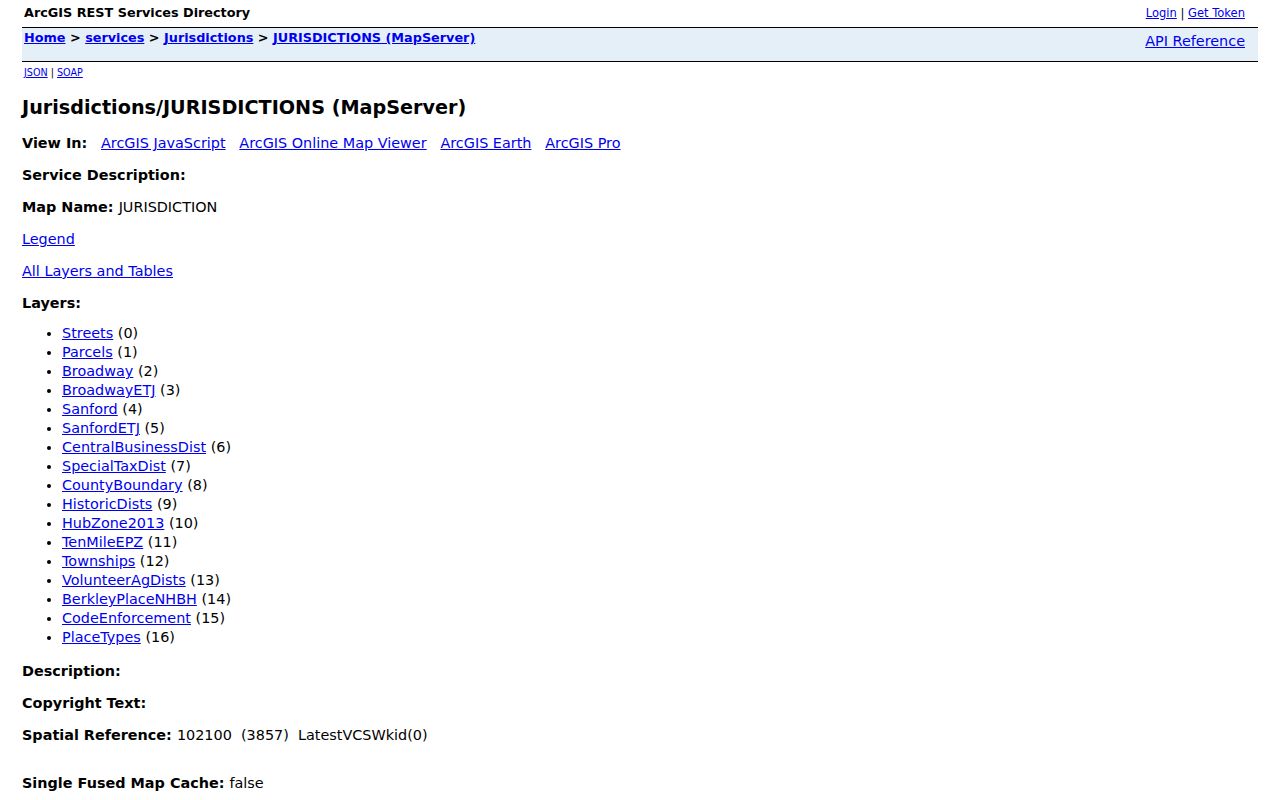
The map can identify a parcel and return a PIN for the property search. It also prevents a common mistake: sending a zoning or permit question to Sanford solely because the postal city says Sanford. When the viewer fails, request the existing GIS layer or parcel data from Lee County GIS under Chapter 132.
Note: Use the parcel PIN, tax jurisdiction, and mapped boundary together before choosing a planning, tax, or records custodian.
Search Sanford Court Records by Name
Lee County is served by North Carolina District and Superior Courts, both within the unified General Court of Justice. The statewide eCourts Portal searches public case information by case number, party name, or business name. Filters can narrow the location to Lee County and the case category. A public docket may show the case number, parties, type, filing date, status, court, events, hearings, disposition, and any public documents.
The Clerk of Superior Court remains the custodian. Public self-service terminals in clerk offices can reach criminal cases by defendant, case number, or victim or witness name and can also show civil, estate, and special-proceeding information. Paper files are reviewed where the case was filed. Sealed, expunged, juvenile, adoption, and other confidential material stays restricted even when the court has moved to eCourts.
| Record forum | Typical matters | Name route | Fallback |
|---|---|---|---|
| Lee Superior Court | Felonies, larger civil cases, appeals, estates | eCourts Portal | Clerk terminal or paper file |
| Lee District Court | Misdemeanors, infractions, family matters | eCourts Portal | Clerk terminal or paper file |
| Middle District of North Carolina | Federal cases | PACER Case Locator | Federal clerk |
North Carolina calls record clearing an expunction. A missing web result does not prove that no case existed, so confirm identity and availability with the correct clerk.
Find Sanford Vital Records
Lee County’s Register of Deeds issues certified county birth, death, and marriage records. Divorce judgments and full court files remain with the Clerk of Superior Court. The North Carolina Office of Vital Records handles statewide certificates and reports, but its divorce certificate is not the underlying judgment. For an event the county can issue, the researched Lee County certified-copy fee is $10, compared with the state’s $24 nonrefundable search for one three-year period.
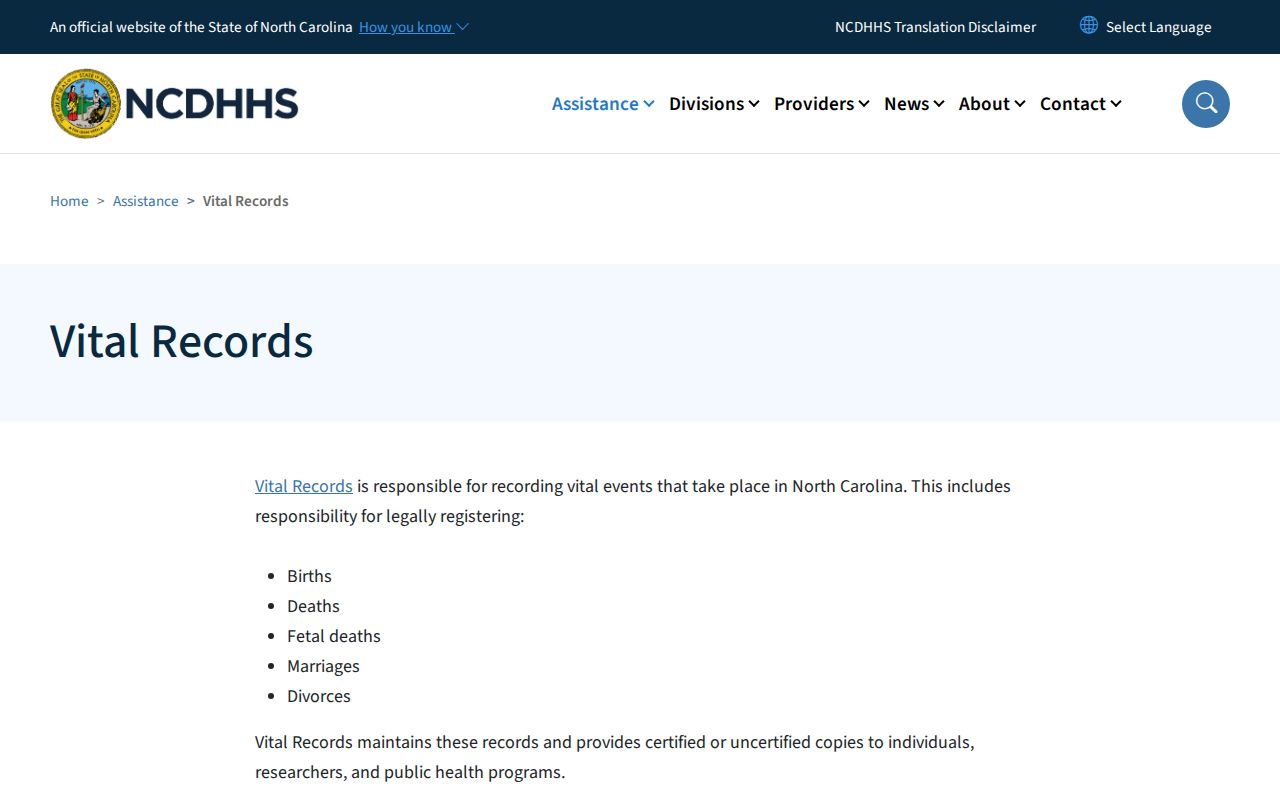
North Carolina uses relationship-based access under G.S. 130A-93. Certified copies are limited to the person, spouse, sibling, direct ancestor or descendant, stepparent or stepchild, or an authorized agent or attorney. Others may be able to obtain an uncertified copy under statutory controls. An order should identify the subject, event, date and place, relevant parents or spouse, the requester’s relationship, delivery details, ID, and payment.
Historical work follows different channels. FamilySearch catalogs Lee birth and death indexes through 1969 and marriage material through 1969 in named series. The State Archives copy service covers defined death, marriage, and divorce periods. Earlier evidence may sit in church registers, cemetery surveys, family papers, newspapers, or the parent counties.
Search Sanford Before Lee County
Lee County was created in 1907 from parts of Moore and Chatham counties. That date creates a jurisdiction break, not a record-loss story. A person could stay in the same physical community while deeds, court matters, probate, marriage, tax, or other records changed county headings. When a Sanford family trail stops before 1907, determine which parent county governed the land or event and search that office and archive series.
The City of Sanford’s historical date record also supplies the city’s incorporation and Jonesboro merger milestones.
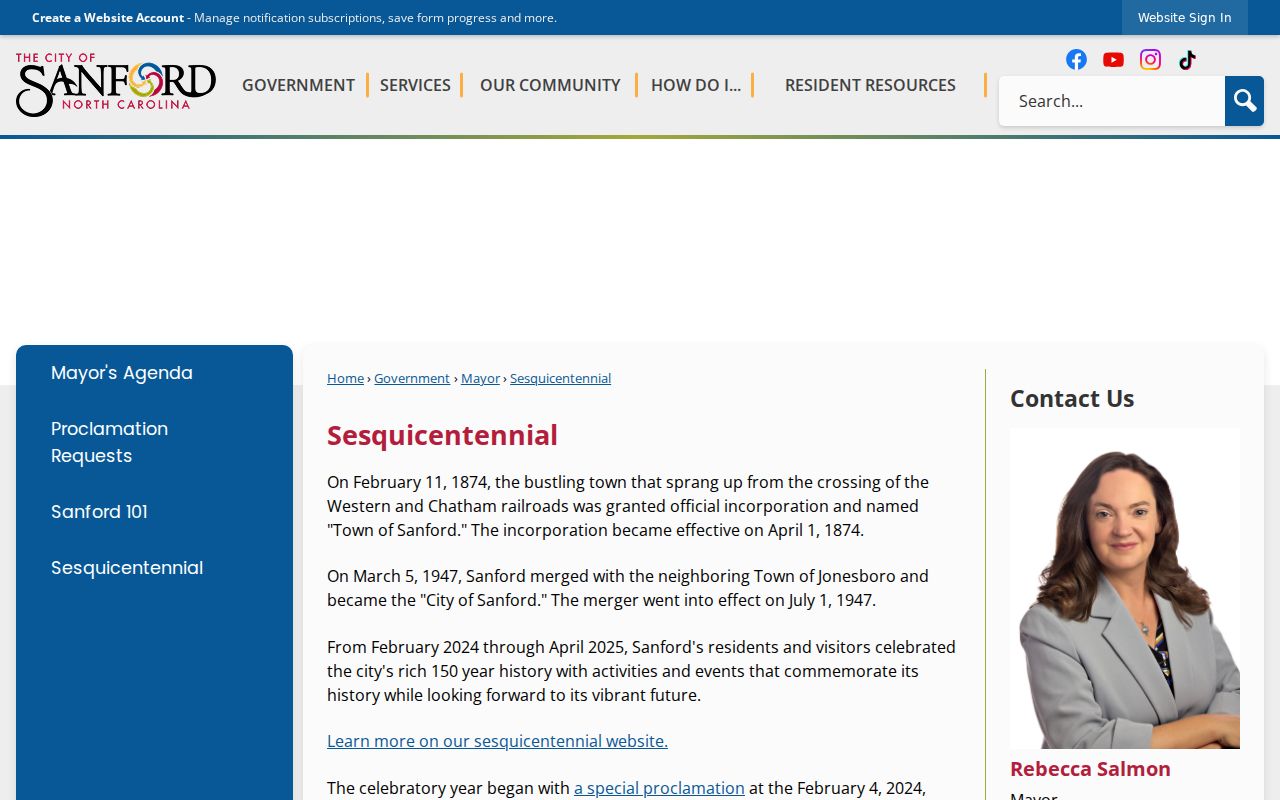
This history changes search terms as well as custodians. Sanford incorporated in 1874 and merged with Jonesboro in 1947. Directories, maps, newspapers, and minutes may keep Jonesboro as a separate place before the merger. Search the two place names independently rather than assuming a modern catalog has merged every entry.
Two pivots matter. Use 1907 for the Lee versus Moore or Chatham county question, and 1947 for the Sanford versus Jonesboro place-name question.
Reverse Sanford Directory Searches
DigitalNC and Lee County Libraries preserve unusually strong local directory material. A 2024 digitization batch added 15 Hill’s Sanford volumes from 1954, 1964, and annually from 1966 through 1978. Other digitized items include a circa-1920s rural mail directory, a 1922 Sanford-Jonesboro telephone directory, a 1962 Sanford High yearbook, and local scrapbooks. The Sanford Express collection adds searchable newspapers from 1887 through 1937.
The 1952 Hill’s volume supports more than alphabetical browsing. Its Street and Avenue Guide turns an old address into occupants and neighbors, while its numerical telephone directory turns a number into a subscriber. Entries can add spouse, occupation, and home address. Rural routes, churches, cemeteries, schools, clubs, courts, and civic offices supply more browse paths when name spelling is unclear.
Use the circa-1920s Rural Mail Directory of Lee County when an address predates a modern street label. Pair its route entry with a census schedule, deed, period map, and a later city directory. The source types answer different questions, so agreement across them is stronger than any one line.
Newspapers and school materials fill a different part of the record trail. DigitalNC has 1,711 issues of the Sanford Express from 1887 through 1937, along with smaller community, African-American, student, and later local titles. Obituaries, marriage notices, school lists, business advertisements, and social columns can connect relatives and dates that an official index omits. A digitized 1962 Sanford High yearbook and local club scrapbooks add faces, class groups, projects, and community roles. These sources are especially useful for reconnecting a family line or former classmate, but a printed name or photo should still be checked against another dated source.
Note: The library’s physical holdings may exceed the documented digitized set; confirm exact editions with Lee County Libraries before travel.
Trace Sanford Business Names
The North Carolina Secretary of State Business Registration Search can connect an organization name to its legal entity record, registered agent, principal office, and filing history. The statewide assumed-name system covers filings after December 1, 2017 and allows a Lee County filter. Older DBA, or “doing business as,” certificates still require the Register of Deeds because the statewide database does not erase the older county filing path.
Start with the state entity search, then check the statewide assumed-name records. If a regulated trade is involved, confirm the person or organization with the issuing board. North Carolina has no single complete license database, so the state’s board directory is a routing tool rather than a universal result set.
| Official source | Relationship shown | Limit |
|---|---|---|
| Secretary of State entity record | Organization, agent, principal office | Not proof of a person’s residence |
| Assumed-name filing | DBA and named owner or entity | Statewide database is post-2017 |
| Licensing board | Credential, status, public action | Search the profession’s own board |
Browse Sanford Archive Records
Sanford’s Archive Center works like a civic people index hidden inside municipal files. Its controls search by keyword, archive category, time period, and start or end date. Annual reports, budgets, board and commission directories, resident guides, preservation newsletters, permit reports, agendas, and related series may identify officeholders, applicants, consultants, board members, or project participants.
The Sanford Archive Center is useful when a staff search has changed or a public role existed only for a short term. The city’s development project database adds named rezoning projects, locations, jurisdictions, and linked public files. Older or unavailable permit records can be requested through Sanford Inspections by address, permit number, type, and date range.
Recent permit records have a system break. The joint Sanford and Lee County portal was upgraded in October 2024, and consolidated central intake began in January 2025 for Sanford, Broadway, and Lee County residential construction applications. Try the current portal first. Ask Inspections for an existing older record when it is absent.
Municipal files work best when the search is framed around a role, project, parcel, meeting, or date. Agencies must provide existing public records as promptly as possible, but they do not have to create a new list or conduct open-ended research. Ask for the native electronic file or inspection first, and identify the narrow record series that should contain the name.
Protect Sanford Search Privacy
Public access is not permission for repeated monitoring, unwanted contact, threats, or harm. North Carolina stalking law addresses a course of conduct that can include following, observing, monitoring, surveilling, threatening, or communicating without a legal purpose. Cyberstalking law also restricts specified threatening communications and unauthorized tracking. Verify identity carefully, respect a refusal to engage, and use public data only for a lawful personal purpose.
North Carolina’s Address Confidentiality Program gives eligible survivors of domestic violence, sexual assault, stalking, or human trafficking a substitute address and mail forwarding. State and local agencies must use the substitute address under Chapter 15C. A protected voter must present the program card and a signed safety statement to the county elections board for the voter-address safeguard.
Commercial profile removal does not erase a government source record. Corrections go to the office that maintains the deed, parcel, court, voter, or other record. If a private directory offers an opt-out, use its privacy route, save confirmation, and recheck duplicate profiles without sending more identity data than needed.
Lawful personal use only. Never use a Sanford address, record, or directory entry to stalk, harass, intimidate, or harm anyone.