
Which Sanford Public Records Are Open
North Carolina law starts with broad access, but each record set has its own keeper and limits. Sanford has no general county clerk who controls every file. Lee County Register of Deeds keeps land instruments and county vital records. The Clerk of Superior Court holds filed court matters. Tax Administration maintains the ownership roll, while city departments keep municipal business such as permits and council records. The quickest channel depends on what was recorded and why.
| Sanford record | Office that keeps it | Web coverage | How access works |
|---|---|---|---|
| Deeds, plats, liens | Lee County Register of Deeds | Current vendor coverage not verified; filmed conveyance index, 1908-1970 | Department portal or office; copy and certification fees apply |
| Civil, criminal, estates | Lee County Clerk of Superior Court | Statewide eCourts Portal | Web search, clerk terminal, then paper file |
| Property roll and GIS | Lee County Tax Administration and GIS | Current profiles and map layers | Free search, CSV export, or property card PDF |
| Birth, death, marriage | Register of Deeds or NC Vital Records | Historical indexes vary by series | Certified copies restricted by relationship; set fees apply |
| Police and custody | Sanford Police, Lee detention, or NC Adult Correction | P2C for city reports; state offender search | Use the responsible agency; call detention for current local custody |
| Permits and city files | Sanford department that made the record | CSS permit portal and municipal Archive Center | Search first, then submit a focused city request |
Open status does not make every detail visible. Sealed or expunged cases, adoption and juvenile files, protected voter addresses, confidential personnel material, criminal intelligence, and protected motor-vehicle data remain outside ordinary access. A mixed file should be redacted so its nonexempt part can be released. Vital certificates and military discharge records also follow rules that are narrower than the general open-record presumption.
Sanford Deed Records Have Limits
The Lee County Register of Deeds is the authoritative place for recorded deeds, deeds of trust, liens, plats, powers of attorney, assumed names, and related instruments. Its current deed-search vendor address, live control labels, and native online start year were not verified in the research. Do not infer those details from another county’s portal. The department page and the office counter are the safe starting points.
A FamilySearch catalog confirms a filmed Lee County real-estate conveyance index for 1908 through 1970. For an office search, give the party’s name variants, an approximate recording date, the instrument type, and book and page when known. The county’s current fee schedule lists uncertified copies at $0.25 per page. A certified previously recorded instrument costs $5 for the first page plus $2 for each added page.
Record terms:
- Index
- A finding aid that points to a recorded item; it is not necessarily the document image.
- Certified copy
- A copy bearing the custodian’s official certification for uses that require authenticity.
- Custodian
- The office responsible for holding and producing a specific record.
- Exemption
- A law that closes a record or detail despite the general access rule.
Note: A parcel’s deed book and page can narrow an office request when the current online deed interface is unclear.
Search Sanford Property Records Precisely
The verified Lee County real-property search is the strongest fully documented online record system for Sanford ownership. It links a parcel owner and tax mailing address to a physical address, PIN, values, permits, deed transactions, legal description, zoning, acreage, and plat cabinet or slide. Mailing and physical addresses are separate fields. A mailing address may identify where notices go without proving that the owner lives at the parcel.
| Search control | Input | Use in Sanford |
|---|---|---|
| Owner Name | Text | Search a surname or business; displayed names may use LAST, FIRST order |
| Property Address | Text | Find the parcel by street number and name |
| Parcel ID / PIN | Text | Use the stable county parcel identifier |
| Account Number | Text | Match the identifier in the Owner block |
| Tax Year | Selection | View the roll in its stated year context |
| Report option | Menu | Choose CSV Export or Residential PRC, then press GO |
Use GIS when the postal city is not enough. Lee County’s layers distinguish Sanford, Sanford ETJ, county land, historic districts, and other jurisdictions. That boundary determines which agency is likely to keep a permit or planning file. If the web search fails, request an existing parcel card or GIS record from Lee County rather than asking staff to create a new analysis.
Sanford Court Records Use Three Channels
Lee County court files belong to the elected Clerk of Superior Court, not to a Sanford municipal court. The North Carolina court-record access instructions describe a three-part route: eCourts Portal, a public self-service terminal, and the paper file held where the case was filed. Portal searches use a case or record number, party or business name, Lee County location, and available case filters.
Public results may show the case number, case style and parties, type, filing date, status, location, hearings, events, disposition, and available public documents. A disposition is the recorded outcome of a charge or case event. Sealed, expunged, juvenile, adoption, and other confidential material does not become open just because the Portal exists.
The courthouse terminal is a crucial fallback. Criminal searches can use defendant, case number, or victim and witness names. Civil, estate, and special-proceeding data are also available. Review the authoritative paper file at the clerk’s office when a web result is incomplete. Divorce judgments come from the clerk that granted them, while the state vital office issues a certificate or report rather than the full judgment.
Sanford Vital Records Follow Relationships
North Carolina does not apply a simple rule that all births or deaths become open after one fixed span. Under G.S. 130A-93, certified copies are limited to the person named, a spouse, sibling, direct ancestor or descendant, stepparent or stepchild, or an authorized agent or attorney. The Lee County Register of Deeds issues county birth, death, and marriage records. The NC Office of Vital Records handles statewide certificate searches.
Lee County’s certified birth, death, or marriage copy is $10. The state’s standard $24 charge is a nonrefundable search of one three-year period and includes one copy if found. Historical access follows different paths: FamilySearch documents a Lee birth and death index for 1876-1969, marriage licenses for 1908-1926, and a marriage index for 1908-1969. State Archives series include death certificates for 1906-1981, marriage records for 1851-1966, and divorce material through 1966.
Note: For an event before Lee County formed, check the Moore or Chatham County office that then governed the place.
Where Sanford Records Are Kept
The main Sanford records desks are close in geography but distinct in authority. Contact the office that made or filed the record. A city clerk cannot certify a deed, Tax Administration cannot supply a court judgment, and the state vital office does not hold the full divorce case. Calling first is useful when the requested year, file format, or certification need is unclear.
Lee Register of Deeds
1300 S. Horner Blvd.
Sanford, NC 27330
(919) 718-4585
Land instruments and county birth, death, and marriage copies
Clerk of Superior Court
1400 S. Horner Blvd.
Sanford, NC 27330
(919) 718-6300
Weekdays, 8 a.m.-5 p.m.; court, estate, and special-proceeding files
Sanford City Hall
225 E. Weatherspoon St.
Sanford, NC 27330
(919) 777-1112
City Clerk, municipal administration, and department routing
Inspections Counter
115 Chatham St.
Sanford, NC 27330
(919) 718-4654
Weekdays, 8 a.m.-4:30 p.m.; permits and inspection files
Sanford Inspection Records Cross Systems
Sanford’s Inspections Division keeps permits, certificates of occupancy or completion, and inspection records. The city directs users to try the CSS permit portal first. A written request then goes through its centralized Inspections mailbox, with an address, permit number, record type, and date range helping staff locate an existing file. The division serves Sanford, Broadway, and Lee County through consolidated intake, so the jurisdiction shown on the parcel and permit matters.
The official Sanford inspections request route shows the online search and request fallback:
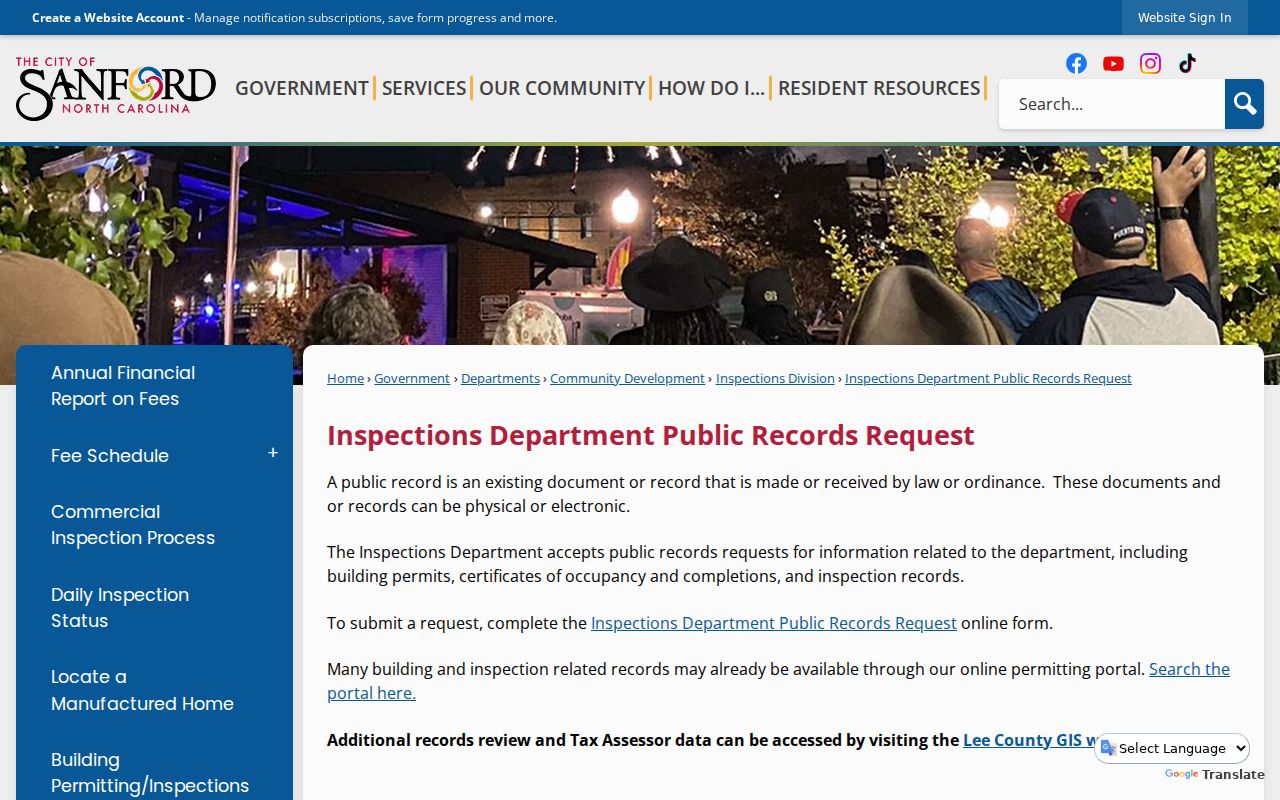
The form’s dynamic field labels were not fully verified, so a requester should describe the existing record instead of relying on guessed controls. The portal upgrade in October 2024 and central intake launched in January 2025 form a system break. Recent applications may be tracked online, while older or missing items may require the city request.
Note: June 2025 flooding briefly displaced Buggy Building offices, but that historical closure is not current access guidance.
Sanford Business Records Split Authority
State business entities, county assumed names, and Sanford merchant permissions are three different records. The Secretary of State entity search can connect an organization with its official name, identifier, status, registered agent, office information, and filing history. Assumed-name certificates filed on or after December 1, 2017 feed a statewide database, but the county where filed remains the source for certified copies. Pre-2017 DBA research belongs with the Lee County Register of Deeds. The North Carolina assumed-name search supports name, date, entity-type, and Lee County filters:
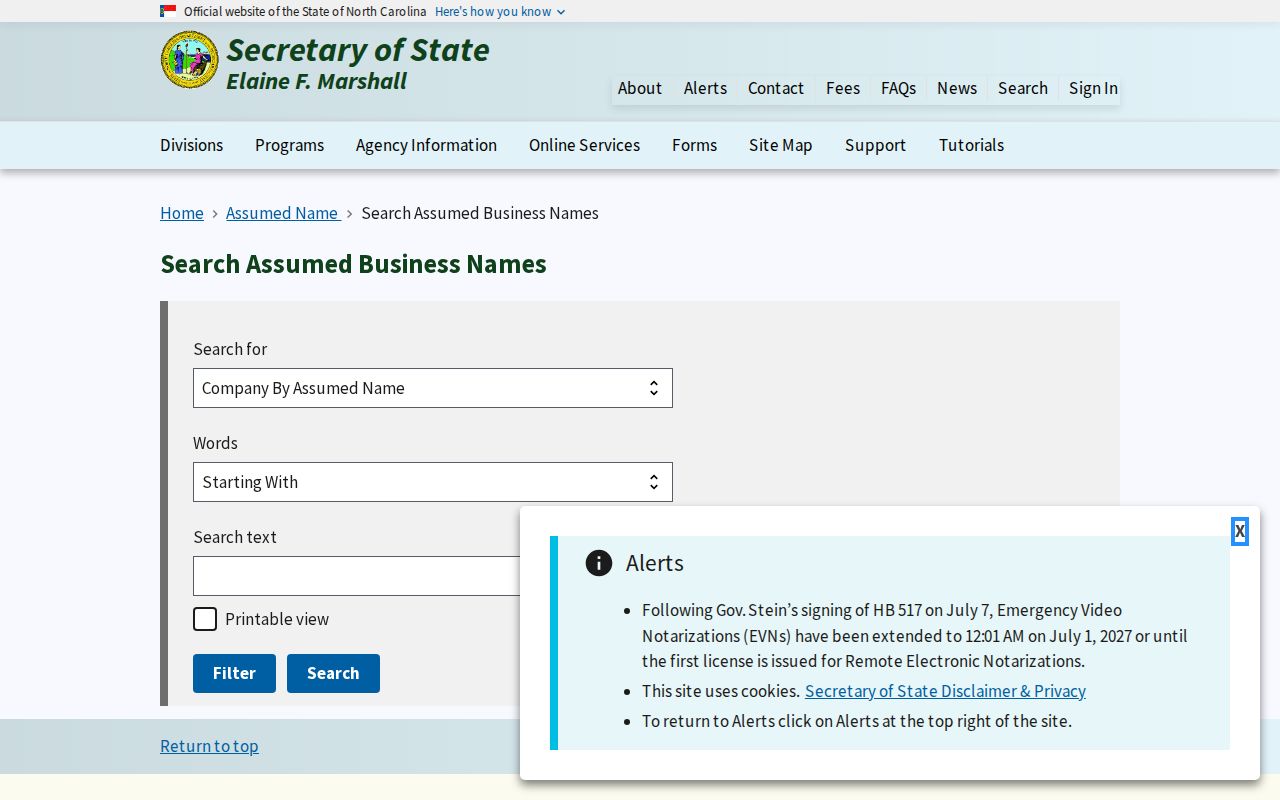
A result can show the assumed name, filing date and county, owner names, covered counties, filing type, and a PDF. That statewide view is a finding aid, not the county-certified record.
Sanford does not require a general privilege license. It has specific rules for beer and wine, peddlers, transient or itinerant merchants, solicitation for alms, and taxis. The city’s merchant-license information shows those limited categories:

No verified public license roster was found. Ask Revenue or the responsible department for an existing record rather than assuming every Sanford business appears in a city database.
Browse Sanford Archive Records by Date
The municipal Archive Center is an underused name source. It searches by keyword, archive category, time period, start date, and end date across series such as annual reports, budgets, board and commission directories, preservation newsletters, permit reports, and resident guides. Those files can name officials, board members, applicants, consultants, and participants while preserving the date and civic role that explain why the name appears. The city’s Archive Center search exposes those category and date controls:
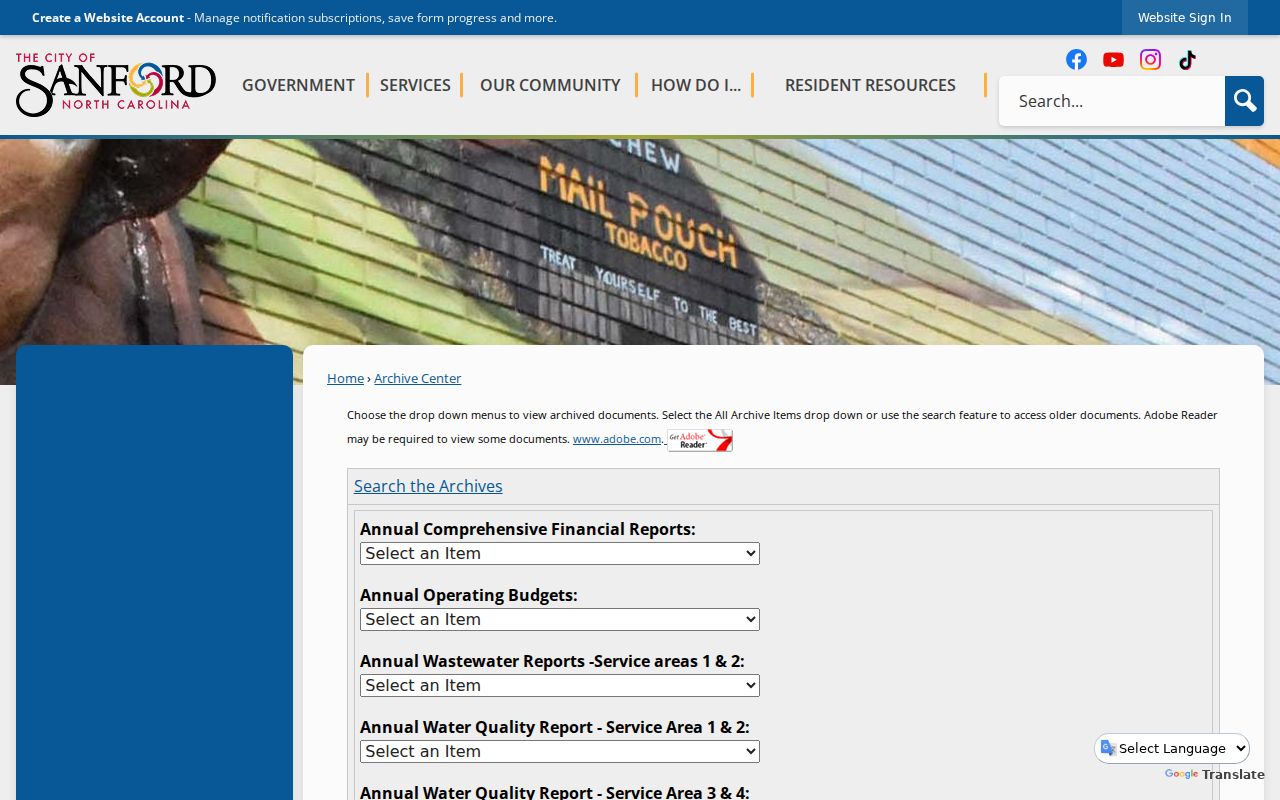
A narrow date range plus a board, project, or surname often works better than a broad citywide query. Archive entries are evidence of public activity, not a general resident list.
The Sanford development project database adds project name, location, rezoning type, and jurisdiction:
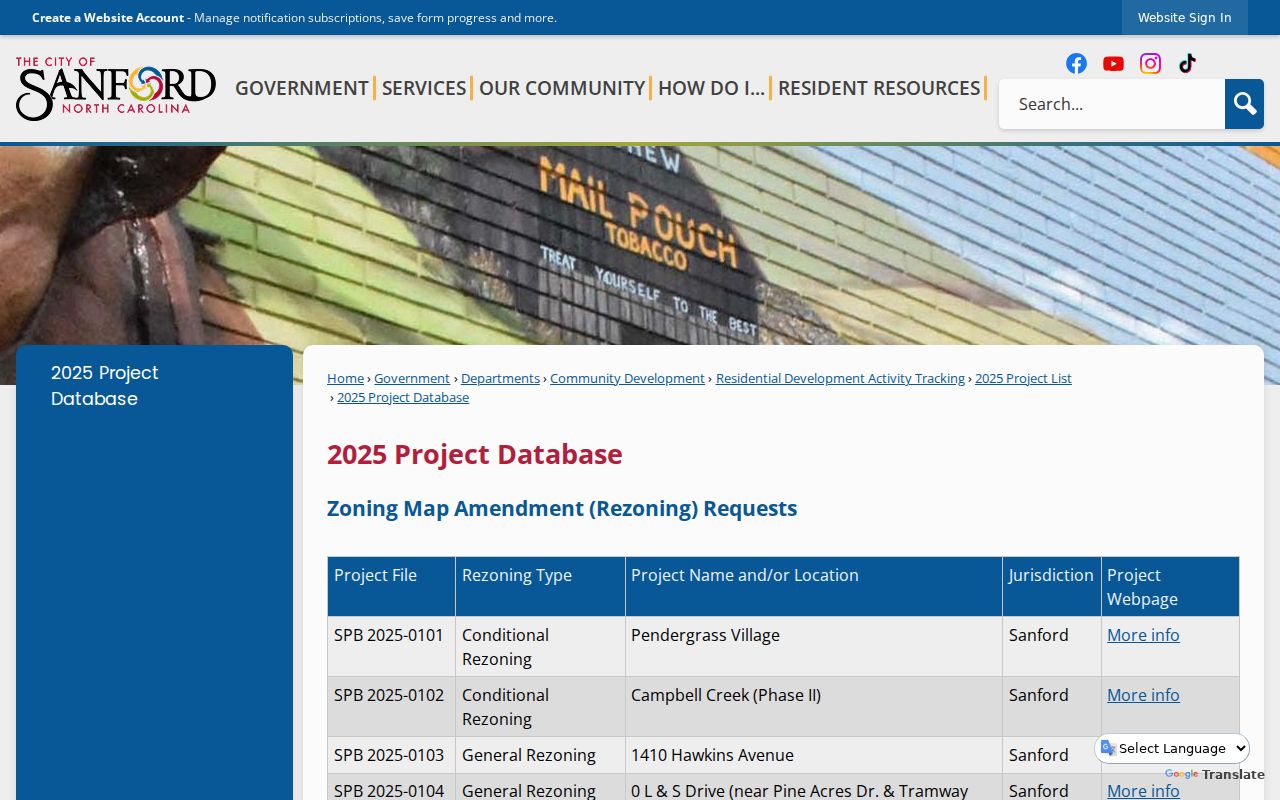
Project pages and hearing files can connect a place to an applicant or representative. Confirm the jurisdiction before requesting the underlying permit, zoning, or hearing record.
Sanford Records Cross Two Boundaries
Lee County was created in 1907 from parts of Moore and Chatham counties. A person, parcel, estate, or marriage tied to the same physical area can appear in a parent county before that date and in Lee afterward without anyone moving. Sanford also merged with Jonesboro effective July 1, 1947. Older directories, maps, newspapers, and government minutes may therefore use Jonesboro as a separate place name.
Modern geography has a second wrinkle. A Sanford postal address can sit outside incorporated city limits or inside the city’s extraterritorial jurisdiction. The GIS boundary and parcel tax-jurisdiction code determine whether Sanford or Lee County keeps a planning or permit file. These two pivots solve different problems: 1907 changes the county record keeper, while 1947 changes the municipal name used by many sources.
Search the right jurisdiction. For pre-1907 records, test Moore and Chatham County. Around 1947, search both Sanford and Jonesboro headings.
Request Sanford Public Records Correctly
North Carolina Public Records Law, Chapter 132, allows any person to inspect covered records at reasonable times and under reasonable supervision. State residency and a stated purpose are not required. Inspection is free. Copies may cost the actual reproduction amount, postage, a fee set by another statute, or a reasonable special service charge when extensive technical or staff work is needed. The law says production must be as prompt as possible, but it sets no fixed number of days.
- Name the custodian. Route deeds to the Register of Deeds, filed cases to the Clerk, property to Tax Administration, and city business to the department that made it.
- Check the official index. A portal result may supply the PIN, case number, permit number, book and page, or date needed for a narrow request.
- Describe an existing record. Give names, addresses, dates, record type, identifiers, and a preferred electronic format. An agency need not answer questions or create a new compilation.
- Ask for cost first. Request inspection or native electronic delivery and obtain an estimate before extraordinary work or certification.
- Handle a denial precisely. Ask for the statute that authorizes withholding and for release of segregable nonexempt portions. Wrongful denial may proceed to voluntary mediation and enforcement under G.S. 132-9.
For NCAOC administrative records, the published copy charge is $0.25 per page and its policy provides a written-denial appeal route. That state office is not the custodian of a case filed with the Lee County Clerk. Likewise, certification must come from the office legally responsible for the document.
Lawful personal use. Access does not authorize repeated surveillance, threats, or unwanted contact. North Carolina stalking and cyberstalking laws apply even when a name or address came from an open file.